







Sailing is one of the most captivating and liberating experiences. It allows us to explore our natural environment with a sense of freedom that can not be found anywhere else. But how does the wind affect the movement of a sailboat? How does it take us from one point to another? These are questions that need to be answered in order to understand the power of the wind and its ability to propel a boat forward.
This article will provide an overview of the basics of sailing and how the wind affects a sailboat’s motion, providing an in-depth analysis of the physics involved in harnessing this energy source. We will also discuss some practical tips for using the wind effectively when sailing, as well as highlight any potential obstacles that must be taken into account. Finally, we will explore ways in which advances in technology have revolutionized sailing and enabled sailors to go further than ever before.
How Does Wind Move A Sailboat?
How does the wind move a sailboat? The answer lies in the boat’s sails. The air pressure caused by wind is what moves a sailboat forward and affects its direction. Sailboats rely on the force created by the difference in air pressure between the two sides of their sails, which pushes them forward. The angle of the sails determines how much power they can generate from the wind, allowing sailors to make adjustments based on weather conditions and their desired course. A skilled sailor knows how to use the wind properly, making small changes in speed or direction to maximize efficiency and safety.
A sailboat’s performance is also affected by the size of its sails; larger sails allow more power from the wind, while smaller ones provide less power but require less effort from the sailor to manoeuvre them. Furthermore, lighter materials such as mylar or kevlar are used for racing boats in order to reduce drag and increase speed. In addition, proper maintenance of a sailboat’s rigging is essential for it to be able to respond effectively to changes in wind speed and direction. All these elements help ensure that a sailboat can take advantage of every gust of wind that comes its way.

What are the advantages of using the wind to propel a sailboat?
The wind is advantageous for propelling a sailboat since it provides a free and renewable source of energy that requires no additional equipment or fuel.
Using the wind to propel a sailboat has several distinct advantages. The first is that wind power is an environmentally friendly source of energy. As long as there is enough wind to fill the sails, a sailboat can be propelled without contributing any emissions or pollutants into the atmosphere. Additionally, using the wind eliminates the need for expensive fuels like diesel or gasoline that are necessary to power motorboats. Finally, harnessing the power of the wind allows sailors to reduce their dependence on electricity which further reduces their impact on the environment.
In addition to cost-effectiveness, harnessing the wind to move a sailboat eliminates the need to purchase fuel or electricity for other types of boats, as previously mentioned. A sailboat also requires less maintenance than a motorboat because it has fewer moving parts and does not have an engine. This reduced upkeep leads to lower overall expenses in terms of repair and replacement costs throughout the lifetime of the boat.
The use of wind power offers many practical benefits for those who rely on sailing as their means of transportation. It provides an economical and sustainable alternative for propelling a sailboat while also promoting environmental conservation through its lack of emissions and pollutant output.
What are the different types of wind direction and strength?
The wind is one of the most powerful forces of nature, and it has a profound effect on the movement of a sailboat. It not only propels the vessel forward but also determines its direction and rate of speed. Wind can be classified into different types based on its direction and strength.
Onshore winds are those that come from overland towards the sea, pushing the sailboat in a southerly direction. Offshore winds come from the sea towards land and propel the boat to the north. Strong winds are usually more advantageous than light breezes because they provide more power to move the boat faster. Conversely, light winds are ideal for sailing in shallow waters or when trying to conserve energy.
When the wind changes direction, it becomes crosswinds which push against the side of a sailboat instead of directly behind it. This results in an unpredictable course and can cause instability or even capsize if not handled properly by experienced sailors. Similarly, gusts occur when winds suddenly become stronger, creating an uncomfortable rocking motion for passengers. These shifts in intensity require quick adjustments to maintain balance and control on a sailboat.
How does wind direction impact the movement of a sailboat?
Wind direction holds the key to understanding how a sailboat moves, and why it is so important for sailors to be aware of wind patterns and changes in strength. The boat must always face into the wind when sailing, regardless of which direction it comes from. As a result, if the wind blows from the left side of the boat, it will turn to the right so as to catch the breeze. Despite your best efforts, your boat won’t move much at all if the wind comes from behind. That’s why understanding the types of wind is essential for any successful voyage!
Understanding where your boat needs to go in relation to the wind can be tricky. If you are heading south while a northerly wind is blowing, then you need to make sure that your boat points slightly eastward so that you can catch some of that breeze and push yourself along. On top of this, you also need to consider how strong each gust of wind is; stronger winds will help propel your vessel faster than weaker winds will.
How does wind strength impact the movement of a sailboat?
A sailboat navigating through the ocean is like a bird in flight, soaring through the air. With the right wind direction, the boat can catch a gust of wind and travel for miles. But it’s not just the direction of the wind that affects a sailboat’s movement, it’s also its strength of it.
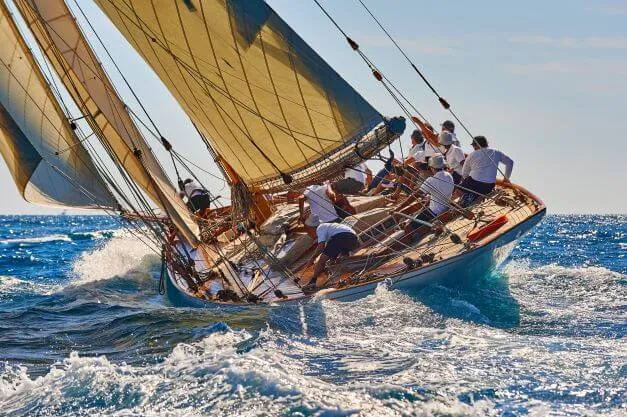
A sailboat’s speed and efficiency are impacted by the strength of the wind. If it is too weak or too strong, progress can be slow or even impossible. To make the most of any breeze available when there is light wind, sailors often use tactics such as tacking and jibing. To prevent capsizing from excess power from gusts of air during strong winds, sailors reef their sails.
No matter how strong or weak the winds are, experienced sailors know how to take advantage of them and use them to propel their vessels forward. Without some kind of assistance from nature’s breeze, sailing would be incredibly difficult and time-consuming. Understanding how wind strength works with boats is essential for anyone who wants to embark on an adventure across open waters.
Conclusion
The wind is a powerful force which can dramatically affect the movement of a sailboat. It has the power to propel a sailboat forward or to slow and stop it in its tracks. Its direction and strength can have an impact on the boat’s speed, trajectory, and manoeuvrability. Wind direction determines which way a boat will travel, and its strength dictates how quickly it will move. When a sailor understands these dynamics, they can use tactics to maximize their boat’s efficiency in windy conditions.
Knowing how to properly read the wind is essential for sailing success. This means studying the patterns of wind direction and strength that are present at any given time. Reading the air currents near the surface of the water is also important for understanding where a sailboat may drift with no input from its sails. By understanding how these forces work together, sailors can make educated decisions about how best to utilize them to navigate their boats efficiently and safely.
At its core, sailing involves utilizing the power of wind in order to move across bodies of water. Understanding how these forces interact with each other is key for the successful navigation of a sailboat, as even subtle changes in wind direction or strength can have large impacts on the movement of a vessel at sea. As such, learning how to identify different types of winds, interpret their effects on sailboats, and adjust one’s tactics accordingly are all crucial skills for any sailor looking to maximize their performance while out on the open water.
Further Reading