







A “fast DCS hit” is diver slang for symptoms that appear very soon after a dive. The safer medical term is suspected decompression illness, or DCI. DCI includes both decompression sickness and arterial gas embolism, and divers should not try to diagnose the exact condition in the field. The initial response is the same: stop diving, give oxygen if trained and equipped, call emergency help, keep the casualty comfortable, and contact diving medical advice.
If a diver has sudden weakness, numbness, confusion, dizziness, collapse, breathing difficulty, chest pain or unusual symptoms after surfacing, treat it as a diving emergency until a diving-medicine professional says otherwise.
Emergency Box: Suspected DCI in the UK
| Situation | What to do |
|---|---|
| At sea | Contact the Coastguard by DSC, VHF Channel 16 or 999 |
| Inland diving in England, Wales or Northern Ireland | Call the BHA/RN Diver Helpline: 07831 151 523 |
| Diving incident in Scotland | Call Aberdeen Royal Infirmary: 0345 408 6008 |
| Immediate life threat | Call 999 and follow emergency instructions |
BSAC lists these UK diving incident routes, and DDRC’s diving emergency advice also says sea-diving incidents should contact the Coastguard, DSC, VHF Channel 16 or 999, then use the National Diving Accident Helpline route where appropriate.

Quick Answer: What Should You Do After a Fast DCS Hit?
If a diver has unusual symptoms after diving, act early.
- Stop all diving immediately.
- Call emergency help.
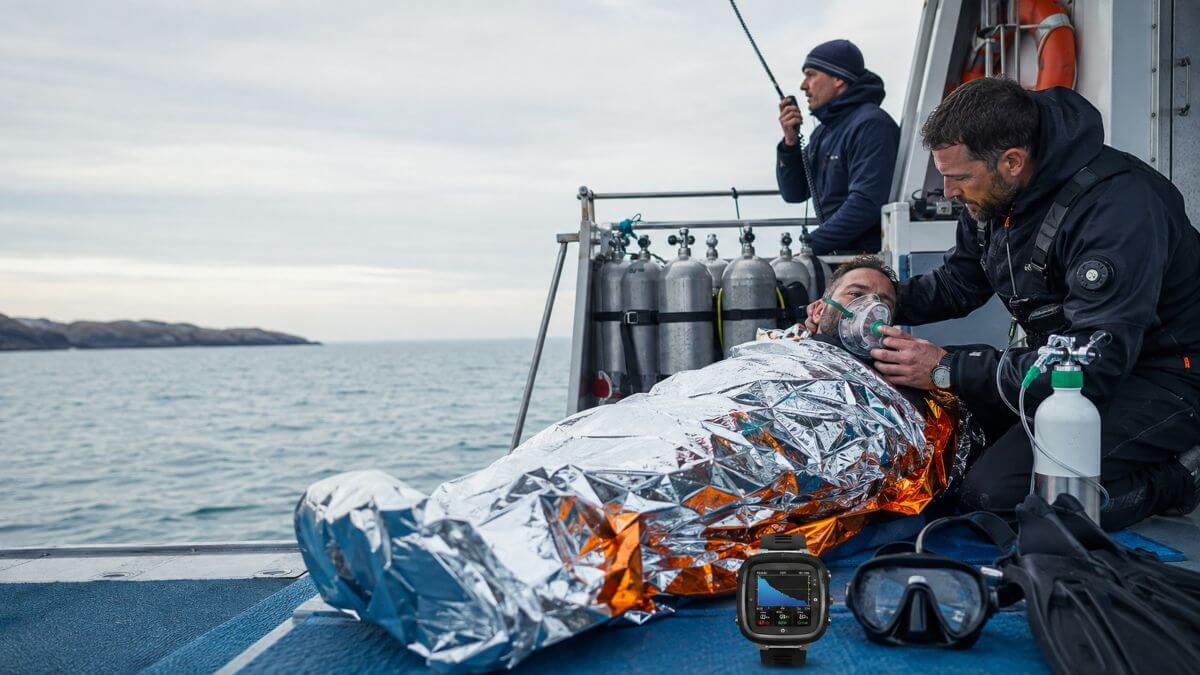
- Give 100% oxygen if trained and equipped.
- Keep the diver lying down, warm and comfortable.
- Monitor breathing, consciousness and symptoms.
- Preserve the dive computer and dive profile.
- Contact a diving medical helpline or hyperbaric service.
- Do not let the diver drive, fly, drink alcohol or dive again.
DAN says the primary first-aid measure for decompression sickness is the highest practical concentration of supplemental oxygen. DDRC advises keeping the casualty lying down, giving 100% oxygen by a tight-fitting mask where available, rehydrating where appropriate, and keeping the patient comfortable.
What Divers Mean by a “Fast Hit”
A “hit” is informal diver language for decompression-related symptoms. A fast hit usually means symptoms appear quickly after surfacing, sometimes within minutes.
A fast post-dive problem may be:
- decompression sickness
- arterial gas embolism
- pulmonary barotrauma
- inner-ear barotrauma
- immersion pulmonary oedema
- contaminated breathing gas exposure
- stroke or another unrelated medical event
- injury, strain or another non-diving illness
Some of these can look similar at first. DAN’s diagnostic guidance lists several conditions that can mimic or overlap with decompression sickness, including ear or sinus barotrauma, contaminated breathing gas, oxygen toxicity, trauma, marine-life injury, immersion pulmonary oedema and coincidental neurological disorders.
The safe question is not:
“Is this definitely DCS?”
The safe question is:
“Could this be decompression illness or another serious post-dive problem?”
If the answer is yes, get help.
DCS, AGE and DCI: What Is the Difference?
Decompression sickness
Decompression sickness, or DCS, happens when inert gas that has dissolved into body tissues under pressure forms bubbles during or after ascent. These bubbles may affect joints, skin, nerves, brain, spinal cord, lungs and other tissues.
Arterial gas embolism
Arterial gas embolism, or AGE, usually involves gas entering the arterial circulation, often after lung over-expansion injury during ascent. It can cause sudden neurological or stroke-like symptoms.
Decompression illness
Decompression illness, or DCI, is the practical umbrella term covering both DCS and AGE. The CDC Yellow Book explains that, from a field-care perspective, distinguishing DCS from AGE may be impossible and unnecessary because the initial treatment is the same for both.
Why Fast Symptoms Are Treated Seriously
Rapid symptoms after a dive can mean serious DCI, especially if the diver has neurological symptoms, breathing difficulty, collapse or loss of consciousness.
Merck’s professional guidance says arterial gas embolism usually has sudden onset during or within a few minutes after surfacing, even from shallow depths if breath-holding or airway obstruction causes lung over-expansion during ascent.
DCS can also appear quickly. Merck says decompression sickness symptoms develop within 1 hour of surfacing in about 50% of affected patients and within 6 hours in about 90%.
The practical lesson is simple:
Do not wait to see whether it passes.
Red-Flag Symptoms After a Dive
Call emergency help immediately if a diver develops any of these symptoms after a dive:
| Red flag | Why it matters |
|---|---|
| Loss of consciousness | Possible AGE, severe DCI or another emergency |
| Confusion or unusual behaviour | Possible neurological involvement |
| Seizure | Emergency neurological sign |
| Weakness or paralysis | Serious neurological red flag |
| Difficulty walking | Possible spinal, brain, inner-ear or neurological problem |
| Numbness or tingling | Possible neurological DCI |
| Severe dizziness or vertigo | Possible inner-ear, neurological or pressure-related problem |
| Difficulty breathing | Possible pulmonary barotrauma, AGE, DCI or IPE |
| Chest pain | Serious post-dive symptom |
| Coughing or frothy sputum | Possible serious respiratory problem |
| Severe headache or vision changes | Possible neurological concern |
| Collapse | Emergency until proven otherwise |
A diver who loses consciousness or develops stroke-like symptoms shortly after surfacing should be treated as an emergency and assessed urgently. Merck says AGE can cause altered mental status, weakness, paralysis, seizures, loss of consciousness, breathing arrest and shock.
Mild-Looking Symptoms Still Matter
Not every DCI case starts dramatically. Mild symptoms may still be important, especially if they appear after diving and were not present before.
Do not ignore:
- unusual fatigue
- joint or limb pain
- skin rash
- itching
- tingling
- numb patches
- mild dizziness
- headache
- vague weakness
- nausea
- clumsiness
- pain that does not feel like normal strain
BSAC warns that divers can dismiss symptoms as strain, fatigue or coincidence, but abnormal symptoms after diving should be checked by medical staff trained in diving-related injuries.
Symptoms During Ascent or Before Surfacing
A fast hit does not always begin after the diver is fully out of the water. Symptoms may appear during ascent, at the surface, on the boat, on shore, or later the same day.
Treat symptoms seriously if the diver reports:
- unusual dizziness during ascent
- sudden weakness
- confusion
- breathing difficulty
- chest pain
- inability to control buoyancy
- trouble communicating
- unusual numbness or tingling
- severe vertigo
- feeling “not right” before or immediately after surfacing
Do not send the diver back down to “fix it.” Get them safely out of the water, start emergency response, and seek diving medical advice.

What a Fast Hit Can Feel Like
Divers may describe a fast hit in different ways:
- “My shoulder suddenly hurt.”
- “My legs felt weak.”
- “I had pins and needles.”
- “I felt dizzy and strange.”
- “I couldn’t walk properly.”
- “I was suddenly exhausted.”
- “I became confused.”
- “I had chest tightness.”
- “I felt better on oxygen, then worse again.”
- “I almost blacked out after surfacing.”
The exact feeling does not prove the diagnosis. The timing, symptoms, dive profile and medical assessment all matter.
Immediate First Aid for Suspected DCI
1. Stop diving
The diver should not return to the water. The rest of the dive team should also reassess the plan.
2. Call for help
Use the emergency route for the location. In the UK, this usually means Coastguard/999 for sea-diving incidents, and the appropriate diving accident helpline route for inland incidents.
3. Give oxygen
Give the highest oxygen concentration available if trained and equipped. Keep oxygen going until emergency or diving medical professionals advise otherwise.
DAN says early oxygen first aid is essential and may reduce symptoms, but this should not change the treatment plan. DAN also says suspected DCI should still be discussed with DAN or a physician trained in dive medicine even if symptoms appear to resolve.
4. Keep the casualty lying down and comfortable
Keep the diver lying down, warm, sheltered and reassured. If the diver is unconscious, vomiting or has airway problems, follow your emergency first-aid training and dispatcher instructions.
5. Rehydrate only if appropriate
If the diver is fully conscious, alert, able to swallow and not vomiting, oral fluids may be appropriate. Do not delay emergency care to give fluids.
6. Monitor symptoms
Record:
- time symptoms started
- first symptom noticed
- whether symptoms are changing
- oxygen start time
- oxygen delivery method
- breathing changes
- level of consciousness
- pain location
- neurological symptoms
- first aid given
7. Preserve the dive profile
Keep the dive computer available. Do not clear, reset or overwrite dive data.
Useful details include:
- maximum depth
- bottom time
- ascent rate
- safety stop or decompression stops
- breathing gas
- surface interval
- repetitive dives
- missed stops
- exertion
- cold exposure
- problems during ascent
- timing of symptoms
DAN says recent dive information such as depth, time, ascent rate, surface intervals, breathing gas and problems during or after dives can help diagnosis and treatment.
What Not to Do
Do not:
- wait to see if serious symptoms pass
- let the diver drive themselves
- let the diver fly
- let the diver dive again
- give alcohol
- give Entonox
- ignore symptoms because they improve on oxygen
- hide a rapid ascent, missed stop or problem from medical staff
- assume a normal dive computer rules out DCI
- attempt in-water recompression as a recreational self-treatment
DDRC says never to give Entonox to a person suspected of DCI, and says oxygen therapy should continue despite apparent clinical improvement.
Why Symptom Improvement Does Not Clear the Diver
Oxygen can reduce symptoms. That is good, but it does not mean the diver is safe to go home, fly, drive or dive again.
DAN says symptoms of AGE and severe DCS may resolve after breathing oxygen from a cylinder but can reappear later, and suspected DCI should still be discussed with DAN or a dive-medicine physician even if signs and symptoms appear resolved.
Use this rule:
Improvement on oxygen is not a diagnosis. It is a reason to keep oxygen going and get expert help.
Other Problems That Can Look Similar
Not every post-dive symptom is DCI, but divers should not use that uncertainty as a reason to delay care.
| Possible problem | May look like |
|---|---|
| Arterial gas embolism | Collapse, confusion, weakness, seizure, stroke-like symptoms |
| Inner-ear barotrauma | Vertigo, nausea, hearing symptoms, imbalance |
| Immersion pulmonary oedema | Breathlessness, cough, chest tightness |
| Contaminated breathing gas | Headache, dizziness, confusion, nausea |
| Musculoskeletal strain | Limb or joint pain |
| Stroke or neurological illness | Weakness, speech problems, confusion |
| Dehydration or exhaustion | Fatigue, dizziness, headache |
Because the field picture can be unclear, treat suspicious post-dive symptoms as a diving medical problem until assessed. The CDC Yellow Book says distinguishing DCS from AGE in the field may be impossible and unnecessary because initial treatment is the same.
What Happens Next Medically?
Medical teams may assess:
- consciousness
- breathing and chest symptoms
- neurological function
- strength and sensation
- balance and coordination
- pain pattern
- dive profile
- timing of symptoms
- oxygen response
- other possible causes
The diver may be sent to hospital, referred to a hyperbaric unit, or treated with recompression or hyperbaric oxygen where indicated. DAN describes recompression as treatment for decompression illness, and Merck’s professional guidance lists prompt transport to the nearest recompression chamber and 100% oxygen by close-fitting mask as emergency treatment measures.
DDRC says divers with chest pain, breathing difficulties, unconsciousness, rapidly progressing neurological DCI or AGE should be taken to the nearest Emergency Department for assessment.
DCS Can Happen Even When the Dive Looked Normal
A dive computer helps manage decompression risk, but it cannot rule out DCI. Symptoms after a dive still matter.
Possible risk contributors include:
- rapid ascent
- missed decompression stops
- repetitive dives
- long or deep profiles
- cold
- dehydration
- heavy exertion
- flying after diving
- altitude exposure after diving
- individual susceptibility
- illness or fatigue
- lung conditions that increase AGE risk
Merck notes that decompression sickness can occur after dives beyond no-stop limits and sometimes after shallower dives, and that AGE can occur from shallow depths if breath-holding or airway obstruction occurs during ascent.
How to Reduce Risk Next Time
Risk reduction is not a guarantee, but good habits help.
Use conservative diving practice:
- stay within your training
- plan conservative dive profiles
- ascend slowly
- make safety stops where appropriate
- avoid saw-tooth profiles
- monitor no-stop limits carefully
- avoid heavy exertion immediately after diving
- stay warm
- stay hydrated
- avoid alcohol before and after diving
- leave suitable time before flying
- keep good buoyancy control
- dive with a competent buddy
- maintain equipment properly
- carry emergency oxygen where appropriate
- know the local emergency plan
- refresh rescue and oxygen-provider training
What the Buddy or Dive Team Should Do
If your buddy may have DCI:
- stop the dive plan
- get the diver out of the water safely
- start oxygen if trained and equipped
- call emergency help
- keep the diver lying down, warm and reassured
- do not leave the diver alone
- collect dive computers
- record the timeline
- note oxygen start time
- monitor symptoms
- follow Coastguard, emergency service or diving doctor advice
The buddy’s job is not to diagnose. The buddy’s job is to recognise that something is wrong and get help moving.
Simple DCI Incident Notes
Use this table to record information while waiting for help.
| Information | Notes |
|---|---|
| Diver name and age | Include known medical conditions if relevant |
| Dive site | Sea, quarry, inland site, shore or boat |
| Dive profile | Depth, time, gas, stops, ascent rate |
| Symptoms | What happened and when |
| First symptom time | Time after surfacing or during ascent |
| Oxygen start time | Include delivery method if known |
| Response to oxygen | Better, worse, same or relapsed |
| Other divers affected? | Important if gas contamination is possible |
| Emergency calls made | Time and who was contacted |
| Dive computer preserved? | Keep available for medical team |
Fast DCS Hit Checklist
Suspect DCI if symptoms appear after diving
- unusual fatigue
- pain
- rash
- tingling
- numbness
- weakness
- dizziness
- confusion
- breathing difficulty
- collapse
Act immediately
- stop diving
- call emergency help
- give oxygen if trained and equipped
- keep the diver lying down and warm
- monitor symptoms
- preserve dive data
- contact diving medical advice
Do not
- fly
- drive yourself
- dive again
- drink alcohol
- use Entonox
- ignore symptoms because they improve
- wait for severe symptoms before calling
Frequently Asked Questions
What is a fast DCS hit?
A fast DCS hit is diver slang for decompression-related symptoms that appear very soon after surfacing. It should be treated as suspected decompression illness until assessed by diving medical professionals.
Can DCS happen immediately after surfacing?
Yes. DCS can appear soon after surfacing, although many cases develop over minutes to hours. Merck says about 50% of affected patients develop symptoms within 1 hour and about 90% within 6 hours.
Is a fast hit more likely to be arterial gas embolism?
Rapid neurological symptoms, collapse or unconsciousness shortly after surfacing raise concern for arterial gas embolism, but divers should not self-diagnose. Treat it as suspected DCI and get emergency help.
Can AGE happen after a shallow dive?
Yes. Merck says arterial gas embolism can occur during or within minutes after surfacing from depths as shallow as 1m if breath-holding or airway obstruction during ascent causes lung over-expansion injury.
What are the first signs of DCS?
Possible first signs include unusual fatigue, joint or limb pain, tingling, numbness, rash, dizziness, weakness, headache or a strong feeling that something is wrong after the dive.
What are the serious red flags?
Serious red flags include loss of consciousness, confusion, seizure, weakness, paralysis, difficulty walking, chest pain, breathing difficulty, severe dizziness, collapse or rapidly worsening symptoms.
Should you give oxygen for suspected DCS?
Yes, if trained and equipped. DAN describes high-concentration oxygen as the primary first-aid measure for decompression sickness.
What if symptoms improve on oxygen?
Keep oxygen going and still seek diving medical advice. DAN says oxygen may reduce symptoms but should not change the treatment plan, and suspected DCI should be discussed with a dive-medicine professional even if symptoms appear resolved.
Should you call 999 for suspected DCI in the UK?
For a serious or life-threatening incident, call 999. At sea, contact the Coastguard by DSC, VHF Channel 16 or 999. BSAC also lists the BHA/RN Diver Helpline for England, Wales and Northern Ireland, and Aberdeen Royal Infirmary for Scotland.
Can you fly after a suspected DCS hit?
No. Do not fly after suspected decompression illness unless cleared by a diving-medicine professional.
Can you dive again the next day if symptoms go away?
No. Do not dive again after suspected DCI until assessed and cleared by a diving-medicine professional.
Can a dive computer rule out DCS?
No. A dive computer helps record the profile and manage risk, but it cannot rule out DCS or DCI. Symptoms after a dive still need proper assessment.
Why should you keep the dive computer?
The dive computer gives medical staff useful information about depth, time, ascent rate, stops and repetitive dives. This can help assessment and treatment decisions.
Related Guides
- Family Scuba Diving: How to Get Kids Started Safely
- Shark Conservation Dive Travel: How to Choose an Ethical Trip
- The UK Coastal Sailing Safety Guide
External Safety Sources
Useful source links:
- DAN: decompression illness and treatment guidance.
- DDRC Healthcare: UK diving emergency and DCI advice.
- BSAC: UK diving incident routes and DCI helpline.
- Merck Manual: decompression sickness and arterial gas embolism.
- CDC Yellow Book: decompression illness and other dive-related injuries.
Editorial Note
Suspected decompression illness is a medical emergency. This page should be reviewed by a diving doctor, hyperbaric clinician or qualified diving medical professional before publication. Emergency contact details can change, so check BSAC, DDRC and local emergency guidance regularly.
Further Reading